


 Xi'an Weitian Electronic Technology Co. , Ltd
Model No.: WT-122
Brand: WEITIAN
Meta Description: L type waveguide Rotary joint, 12.75-14.5GHz, VSWR≤1.3, IL≤0.3dB, 100W, FBP120 flange, IP45. Aluminum white paint for radar and aerospace.
Looking for a reliable L Type Waveguide Rotary Joint for your radar or aerospace platform in Europe? As Foreign Trade Director at Xi'an Weitian Electronic Technology Co., Ltd., I work with radar integrators and aerospace engineers across Germany, the UK, France, and Italy who share a common challenge: finding a rotary joint that maintains stable RF performance through continuous rotation, without signal fluctuation or mechanical wear over thousands of cycles.
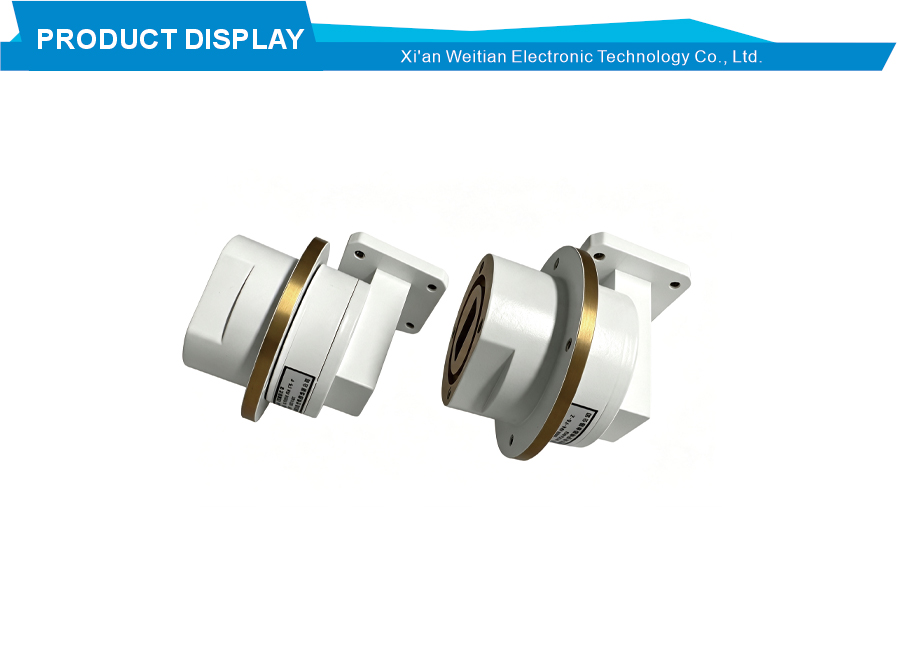
This 12.75-14.5GHz Waveguide Rotary Joint is designed to address exactly that. The L-shaped structure places the input and output axes at right angles, which is convenient when your radar feed layout requires the waveguide path to turn a corner. During installation, the RF path is typically routed through a Waveguide Bend and paired with a Waveguide Adapter if transition to another interface is needed. For test setups, the rotating port can be terminated with a Waveguide Load during calibration.
With VSWR ≤1.3 and insertion loss ≤0.3 dB across the full band, and a VSWR variation held within 0.05 throughout 360-degree rotation, this Waveguide Rotary Joint for Radar provides the consistency that European defense and aerospace programs expect. The unit handles up to 100 W average power, uses an FBP120-FBM120 flange, and is built from aluminum with a white anodized finish and IP45 protection rating.
| Parameter | Specification | Europe Localization Note |
|---|---|---|
| Structure Type | L type | Offset input/output axes in L shape |
| Frequency Range | 12.75 - 14.5 GHz | Ku band used in European air surveillance and naval radar |
| VSWR | ≤ 1.3 | Measured across full band |
| VSWR Variation During Rotation | ≤ 0.05 | Stable through 360 degree rotation |
| Insertion Loss | ≤ 0.3 dB | Including rotating contact path |
| Insertion Loss Variation | ≤ 0.05 dB | Consistent during continuous rotation |
| Average Power | ≤ 100 W (CW) | Suitable for medium-power radar feeds |
| Waveguide Flange | FBP120 - FBM120 | Matches Ku-band flange patterns common in European radar systems |
| Material | Aluminum | Lightweight, suited to airborne and mobile platforms |
| Surface Finish | White anodized paint | Corrosion resistant, suitable for outdoor shelters |
| Protection Rating | IP45 | Dust protected and water splash resistant for field enclosures |
| Quality System | ISO 9001:2015 certified | In-house RF testing per unit before shipment |
| Customization | Flange and interface options available | Configurable based on system requirements |
| European Market Segment | Buyer Type | Local Pain Point | Our Product Advantage (Quantified) |
|---|---|---|---|
| German radar industry | Radar integrators and subsystem suppliers | Require components with proven reliability for air surveillance and ground radar programs | VSWR ≤1.3 with rotation variation within 0.05; IL ≤0.3 dB; IP45 rating for outdoor radar shelters |
| UK aerospace and defense | Avionics and radar equipment manufacturers | Need compact, lightweight rotary joints for airborne and naval platforms | Aluminum construction keeps weight low; L-type offset saves mounting space; 100 W power handling |
| French radar and satellite | Radar and satcom equipment builders | Require consistent RF performance in dual-use civil and defense systems | Rotation variation held within 0.05 dB; ISO 9001 quality system; in-house per-unit RF test reports available |
| Italian and Nordic defense electronics | Naval radar and ground-based system integrators | Need durable components that resist field conditions | White anodized aluminum resists corrosion; IP45 protection; works alongside Standard Gain Horn in antenna calibration setups |
Q1: What is the difference between an L type and an I type waveguide rotary joint?
A: The L type has its input and output axes offset at right angles in an L-shaped housing, which suits radar feed layouts where the waveguide path needs to turn a corner. The I type is a straight inline configuration. If your system layout requires a right-angle turn between the fixed and rotating sections, the L type is the appropriate choice.
Q2: Can the flange type or mounting interface be customized?
A: The standard configuration uses FBP120-FBM120 flanges. Other flange types and interface options can be discussed based on your system requirements. All custom configurations go through the same in-house RF testing as standard products.
Q3: How does the rotary joint maintain stable VSWR during rotation?
A: The internal design uses a non-contact choke structure that keeps the RF coupling constant as the joint rotates. This results in VSWR variation staying within 0.05 and insertion loss variation within 0.05 across the full 360-degree rotation range.
CTA: Contact our RF engineering team today for a datasheet, custom flange configuration, or technical discussion for your European radar or aerospace program.


 Contact Now